
Nantes, France, isn’t one of those places that people generally fawn over. It has an intriguing history that might get some tourists interested in a confluence of cultures, but it’s just not as classically “pretty” as some of the other heavy-hitters in France.
We can’t all be Giverny, or even Pont-Aven, my new favorite Breton alternative for fans of artists’ old haunts.
On our last trip to Brittany, Nantes was one of the last cities we had on our to-do list. (I’ll get into why it’s no longer a part of Brittany, by the way. It’s all very dramatic.)
It just so happened that our visit to Nantes landed on our 12th wedding anniversary, too, so we were really taking a risk here.
I’m kidding. The vast majority of places are worth seeing for yourself, if only so you can complain about them later. Nantes just wasn’t one of those places!
Quick Tips for Your Nantes Visit
Your Flight: You’ll likely start at Paris Charles de Gaulle and take a high-speed train from there to Nantes if you’re not driving. Use Skyscanner to explore your options. Love those deals? Subscribe to Going.
Your Accommodations: We were in Nantes on a day trip from nearby Brittany. Browse Booking.com or Hotels.com for your options in Nantes. Vrbo is my Airbnb alternative.
Your Ride: You don’t need a car if you’re just visiting Nantes, but it may be useful if you hit the road after. Book a rental car for your road trip ahead of time.
Top Spots: Marvel at Le Grand Éléphant, walk the château’s ramparts, and take some glamour shots in Trentemoult.
Disclosure: Travel on the Reg uses affiliate links to keep things running around here. At no additional cost to you, I earn a lil’ commission if you make a purchase. Any income earned supports the upkeep of this site. I appreciate you!
Is Nantes worth visiting?
Nantes is worth visiting as a stopover on travel in the region, whether that’s Brittany or the Pays de la Loire.
It’s light on the tourists, which automatically makes it feel more authentic, and has an artsy, alternative vibe that we tend to gravitate towards in our travels.
While there are certainly places that have wowed us more from an aesthetic perspective, we still found Nantes to be very much worth your time. That’s especially true if you’re seeking a cultural escape.
Nantes is easy to get to.

From Paris, the high‑speed TGV can drop you off in Nantes in just over two hours. Nantes Atlantique Airport offers direct flights from major European cities, and bus and tram connections make getting around the city straightforward once you arrive.
We drove to Nantes from our base of Muzillac on our Brittany road trip, but there are more interesting towns for you to base yourself in if you’re not staying in Nantes proper.
If you drive, you may hit some traffic if you’re here on weekends. We searched around for free parking for a bit, but ended up leaving the car at a paid spot on the street for the day. It was very cheap, so I’m not sure why we put so much effort into being cheaper!
This is a city with personality.
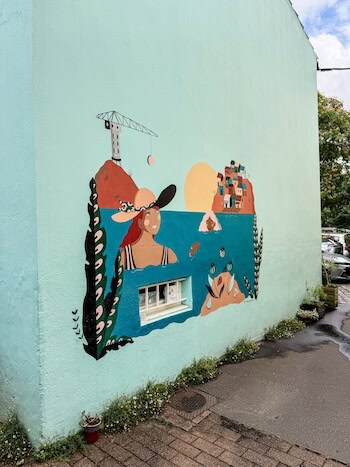
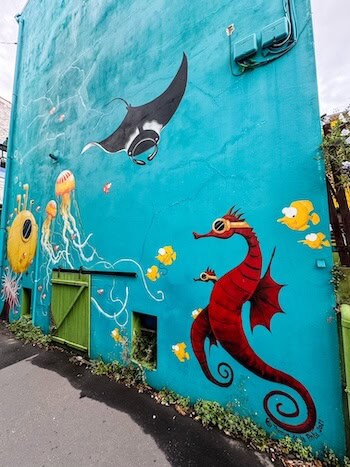
Nantes has a bold, creative spirit that’s pretty obvious upon arrival. Once an important trading hub in the region, it has since reinvented itself as a center of art, culture, and innovation.
The Machines de l’Île showcase, something I’ll dig into in a bit, is a prime example of that. This is a city with boulevards and medieval streets that coexist with street art and cafés that feel less than historic, but that only makes this place more confidently unique.
Nantes has a chip on its shoulder, in the best way.

Once the proud capital of Brittany, Nantes was separated from the region in 1941 after the Vichy government, led by Philippe Pétain, redrew France’s administrative map. Nantes was placed in what would become the Pays de la Loire region.
READ MORE: Visiting the Loire Valley in your travels? I have a guide to the best castles!
The reasons for this come down to identity. At that time, Brittany was displaying some intense cultural nationalism. The thinking was that reorganizing not only borders but also local economies would weaken traditional regional identities across Brittany.
It’s a decision that still stirs debate, as the change was never reversed after the war. This is despite decades of movements advocating for reunification with Brittany.
Fun fact: Polls show that over ⅔ of Bretons and over ¾ of people in the Loire-Atlantique, a department in Pays de la Loire, are in favor of reunification. Opponents say that the region couldn’t exist without Nantes, an economic powerhouse that sits behind Paris and Lyon.
Nantes has a blended identity.
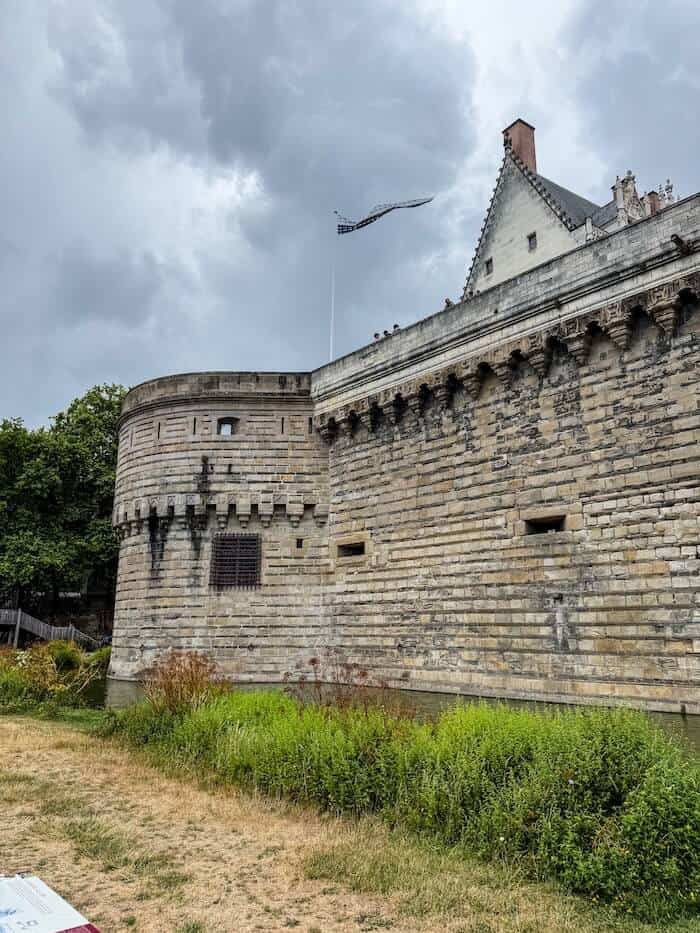
The city’s history has left Nantes quite Breton. It remains a hub for Breton food and festivals, and Celtic-inspired art.
Its history as the Duchy of Brittany’s capital — that means before Brittany was France, it was an independent territory ruled by a duke or duchess — lingers in its architecture.
Many residents still identify strongly with Brittany and fly the Gwenn ha Du flag, or the flag of Brittany.
This is a city that was Brittany before it was France. Rather than shrinking away after that bad luck, Nantes has channeled its complicated history into creativity, resilience, and innovation that make up its unique character.
It has a strong cultural presence.

Nantes is known for its urban art scene. If you need some guidance on where to start, the Green Line painted through the city leads you to some of the city’s best murals, cultural stages, and monuments.
You can also just wander and find where the city has blurred the boundaries between public spaces and exhibitions. At times, Nantes feels like an open-air gallery.
Take the fountain at the Place Royale as an example. On a usual day, the 1860s-era fountain reflects the city’s rapid growth in the 19th century.
Allegorical figures represent the Loire River, and a white marble statue in the middle represents Nantes herself, personified.
On our visit, the fountain was redecorated as a great example of how the city approaches conservation and contemporary art.
The original allegorical figures were removed (before being restored) and replaced by figures representing Nantes’ modern-day economic sectors.
The result is called the Latest Version by Dutch artist Willem de Haan, and it’s an example of the kind of thing the city does quite often.
There are lots of free things to do in Nantes.
Nantes is great for budget‑friendly exploring, and many of its more unique experiences are completely free.
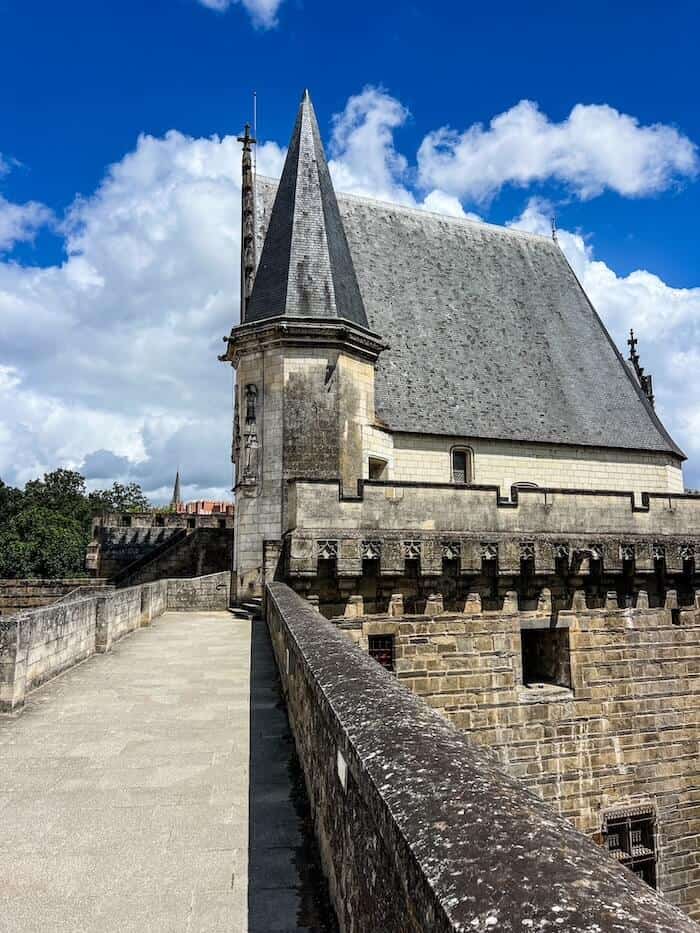
I’ve already mentioned the Green Line, the city’s self-guided art trail, but you can also walk the Château des Ducs de Bretagne courtyard and ramparts for free.
Entry in the museum at the château isn’t free, but I’d argue the best experience is getting the view from along the wall. I’d suggest walking all the way around to see how the perspective changes.
More free activities include the Jardin des Plantes, a 19th‑century botanical garden, and exploring the Île de Versailles, a Japanese‑style garden on a Loire river island.
The city’s churches, like the Cathédrale Saint‑Pierre et Saint‑Paul, are free to enter. You can’t say that about everywhere. I’m looking at you, Italy and England.
It’s home to Le Grand Éléphant.
Les Machines de l’Île, a steampunk wonderland inspired by author Jules Verne, should be at the top of your list if you’re traveling with kids.
If you aren’t, as we were, you should still visit to see Le Grand Éléphant, a nearly 40-foot-tall mechanical elephant housed here.
This thing marches up and down the former shipyard, spraying down unsuspecting (OK, most are suspecting) visitors with water from its trunk. We didn’t want to pay to ride it, but you could’ve twisted my arm, honestly. It looked like a lot of fun.
Check it out in the clip below:
You’ll have to pay to enter the full exhibit — the carousel is super popular — but visiting the elephant is completely free. It does not disappoint.
Note: If you’re a fan of Verne, a Nantes native, visit the Jules Verne Museum dedicated to the French writer. Reviews aren’t great due to the lack of English and odd hours, but don’t let that stop you if you’re psyched about it.
It’s pretty easy to get around.
Nantes is pretty walkable if you stick to its historic city center. If you don’t have access to a car while you’re here to see the rest, the city’s public transit is efficient and accessible.
Nantes has three tramway lines, rapid bus transit, and scenic river shuttle routes that are integrated into the ticketing network. For regional travel, access Nantes’ light rail to reach nearby towns.
The weather was too inclement for us to make use of the city’s bike lanes, but Nantes also boasts an extensive bike lane network.
Fun fact: It’s second only to Toulouse for total kilometers!
Talensac Market is impressive.
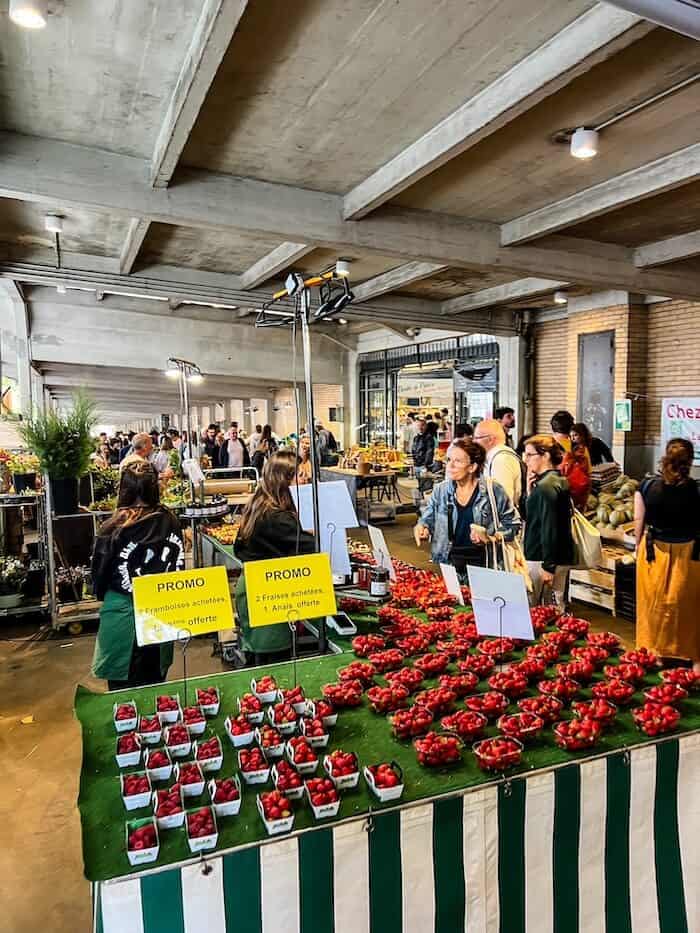
Visiting Talensac Market is a great way to introduce yourself to Nantes and the local culture. That’s where we started on our day here.
We had plans for brunch after, so we didn’t partake in too much, but I couldn’t deny myself some of their very affordable cheeses at one of the cheese counters. The market has been open since 1937 and has grown to over 150 vendors.
Note: It’s a good activity when the weather in Nantes isn’t cooperating, as it’s completely covered.
You can certainly make a meal out of your visit here, or just visit for a sensory dive into flavor town. Visit from 8am-1pm Tuesday to Friday and from 8am-1:30pm on weekends.
If you visit on a Monday that is also a public holiday, the market will be open. They’re givers like that.
There are spots of loveliness.
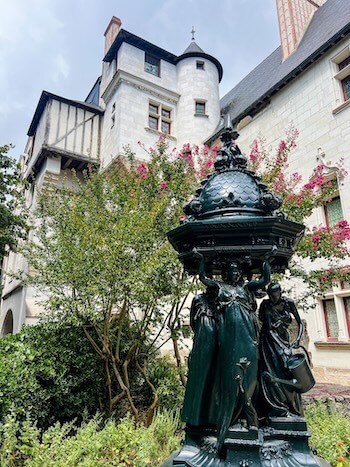
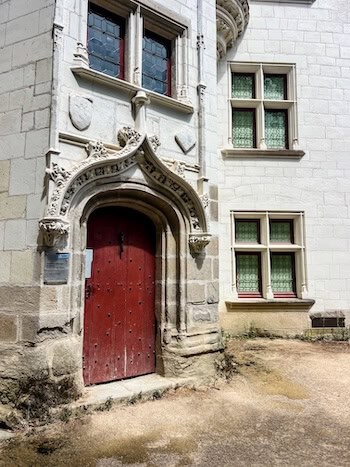
Despite Nantes’ relative grit and industrial past, there are countless spots of loveliness throughout the city.
The Jardin des Plantes and Île de Versailles immediately come to mind as essential destinations, but you may have to work a little harder for some of the others.
The Cathédrale Saint-Pierre-et-Saint-Paul was closed for renovations during our visit, but take a walk behind the church to see the beautiful La Psalette. It’s a photogenic little garden that offers a nice view of the church without scaffolding getting in the way.
The Passage Pommeraye is an incredible 19th-century shopping arcade that offered us a respite from the rain. While most of the boutiques inside were closed, it was still worth a look to check out its glass roof and ornate ironwork.
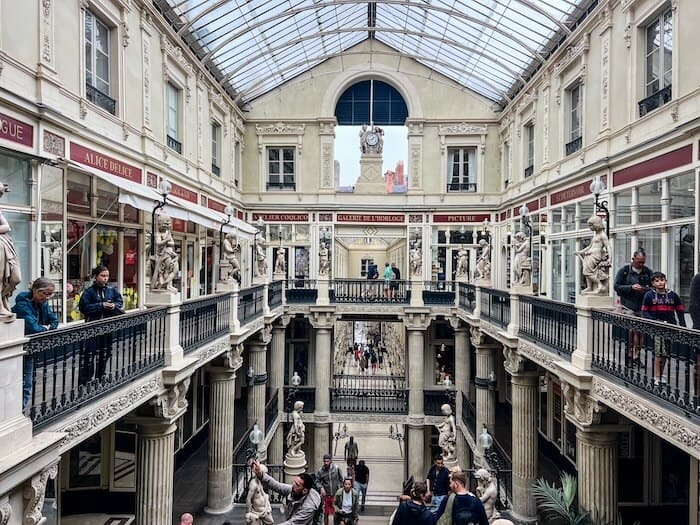
The medieval houses of the Bouffay district and the terraces of Place Graslin are both lovely, and even the city’s former shipyards were repurposed for something wonderful. (I already told you about that incredible elephant.)
These pockets of beauty and imagination reveal a softer side of the city, proving Nantes is far more than its reputation.
READ MORE: Marseille is, actually, as chaotic as they say. Check out my one-day guide!
Trentemoult is like a mini Burano.
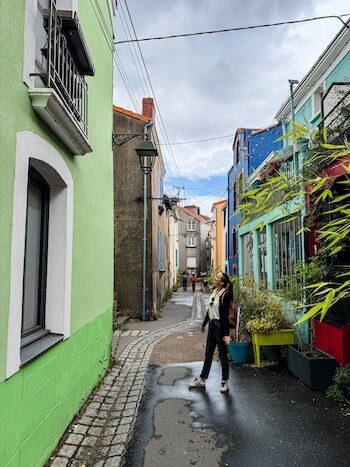
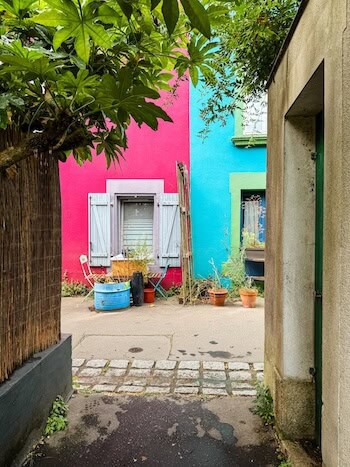
Let’s continue with those lovely vibes for a minute and talk about Trentemoult, a former fishing village just across the Loire that is now part of Nantes proper.
This is a fun spot already to grab a scenic cocktail by the water, but we were here to check out the colorful houses.
It was very much reminiscent of Burano, an Italian island on the Venetian lagoon, just on a smaller, much less crowded scale.
We loved walking through the alleyways to check out the brightly painted houses in shades of red, yellow, turquoise, etc., for a Mediterranean vibe you wouldn’t expect here.
This area, which was once home to mariners, now attracts artists and bohemians, and the vibe is very much along those lines. Some of the homes have murals or quirky details added to them. I loved it.
Nantes has a great food scene.

Nantes has a diverse food scene that includes the expected French classics with traditional Breton flavors and innovative modern eats.
We enjoyed brunch to start our day at Dînette. I was a little wary of the price, but it ended up being a lot of food. The full menu includes a main, a hot and cold drink, a side, and a dessert. The eggs Benedict and homemade banoffee pie were the stars!
For later in the day, La Cigale is a popular brasserie for those seeking something a little classy. La Mandale is a trendy bistro that offers great value for inventive dishes featuring smoked fish, kimchi, shiso, and Gorilla peppers.
Wherever you go, you’ll likely find dishes inspired by both Breton cuisine and the Loire, as that’s just how Nantes rolls.
It’s a good base for day trips.

We were only in Nantes for the day, but if you want to linger for a while to get to know this one more, it’s a great base for travel in the region.
Here are a few options with drive times, but note that you may be able to get somewhere quicker using public transit:
- Angers (1 hour): This city is known for its medieval Château d’Angers, home to the extraordinary Apocalypse Tapestry. If that doesn’t intrigue you, riverside promenades along the Maine are a must.
- Clisson (35 minutes): This medieval town is known for its Italian-inspired architecture and historic Château de Clisson ruins. It’s also surrounded by vineyards, and you know I love a good wine country.
- Le Croisic (1 hour 15 minutes): This cute fishing village doesn’t offer much in the way of attractions, but it’s a perfect trip to share some shrimp and oysters with water views. A long walk to Phare du Tréhic, the town’s lighthouse, doesn’t suck.
- Le Hézo (1 hour 20 minutes): We visited this small commune near the Gulf of Morbihan for La Maison du Cidre with no regrets. I say that because we went home with a box of goodies. We didn’t do a tour, but the tastings here are a good time.
- Parc Naturel Régional de Brière (45 minutes): This wetland reserve was on our list because it’s home to the Michelin-starred La Mare aux Oiseaux. You can visit for the abundant birdlife and hiking trails, though.
Where to Stay in Nantes
We visited Nantes on a day trip from Muzillac, one of our base towns in Brittany. I wouldn’t recommend it unless you’re traveling with a dog as anxious as ours. It was fine, just sleepy! If you want to hang out in the city, you have lots of options.
Use the map below to browse hotels and apartments in Nantes:
Nantes is an underrated French city.
I admit I was more curious than psyched about visiting Nantes. Much of what I’d read about it was pretty harsh. Now that I’ve been, I can say I really like this one. Nantes never pretends to be something or ditches authenticity for the sake of tourism.
There’s something noble about everything Nantes has been through, too. This one is definitely worth a look, especially if you’re already exploring Brittany or the Loire Valley.
Traveling elsewhere in France? Check these out:
- How to Plan a Perfect French Summer
- You Can Visit Versailles in a Better Way!
- Things We’ve Learned From French Living
- A One-Day Itinerary for Lovely Lille
- How to Spend Some Time in Montpellier
More guides for trips to France:
- Why You Should See Fontainebleau
- How to Plan a Trip to Lovely Évian
- See One of France’s Best Christmas Towns
- Your Guide to Planning Trips to France
- Visiting Monaco on Trips to Nice

Want to see more?
Subscribe to my biweekly newsletter for hot travel tips I come across, weird stories you won’t see elsewhere and perhaps lifelong friendship.
Too much, or just enough?
