
Colca Canyon is one of Peru’s big natural attractions, but it’s the resident birds that make it extra famous. This is the best and most reliable place on the planet to see Andean condors, the world’s largest bird of prey, in the wild.
If you love a good wildlife excursion, I’ve probably already hooked you. But there are a few things to keep in mind, namely that getting to Colca Canyon is a whole thing.
A day trip to Colca Canyon from Arequipa means an extremely early start, a long drive, and a very long day. Multi-day trips are another option, but then you’re eating into the rest of your Peru itinerary. So, is Colca Canyon worth it?
We went to Colca Canyon for the day on our last trip to Peru. I’ll get into what it was actually like, how much time you really need, and whether I’d recommend the day trip we did or a multi-day alternative.
Quick Tips for Your Colca Canyon Visit
Your Flight: Most international travelers will fly into Jorge Chávez International Airport (LIM) in Lima. You can take a domestic flight to Alfredo Rodríguez Ballón International Airport (AQP) in Arequipa.
Find deals to both on Skyscanner. Love deals? Subscribe to Going.
Your Accommodations: Browse Booking.com or Hotels.com for your options, whether that’s in Arequipa or closer to Colca Canyon. Vrbo is my Airbnb alternative.
Your Ride: You won’t need a car for a trip to Colca Canyon. If you’re planning a road trip elsewhere whiel in Peru, book a rental car ahead of time.
Top Spots: You’re here for Colca Canyon, but views from Mirador Antahuilque and wildlife-spotting in the Salinas and Aguada Blanca National Reserve are also worth your time.
Disclosure: Travel on the Reg uses affiliate links to keep things running around here. At no additional cost to you, I earn a lil’ commission if you make a purchase. Any income earned supports the upkeep of this site. I appreciate you!
Is Colca Canyon worth it?
In my opinion, yes. Seeing Andean condors soaring over one of the deepest canyons in the world was worth the trip for us, even though we just had the day.
If you have the time for an overnight or two-day trip, I’d consider it, but we didn’t have that kind of time.
From Arequipa, the popular day trips start ridiculously early and can last up to 16 hours once you factor in all of the driving and stops along the way there and back.
Was that a long day? Yup. Was I happy we went? I’d say so.
So, I’d say that if you have the time, go, but don’t confuse “worth it” with “easy.”
What is Colca Canyon?

Colca Canyon is a huge canyon in southern Peru, about 136 miles (220 kilometers) from Arequipa. The scenery here is dramatic, but it’s best known as a spot to see Andean condors.
Fun fact: These birds are the largest raptors in the world, with wingspans that can reach about 11 feet.
One of the most popular stops to see them is Cruz del Cóndor. The birds use the rising thermal currents from the canyon to soar overhead, sometimes passing surprisingly close to the viewpoint.
It does get crowded here, but they don’t seem to mind that, either. The shrieks from people watching them swoop were almost as good as seeing the birds so close. Almost.
The region is also home to pre-Inca agricultural terraces, small Andean communities, volcanoes, and wildlife like vicuñas, alpacas, and llamas. Guided tours will tick off most of these experiences, too.
What to Expect on a Day Trip to Colca Canyon
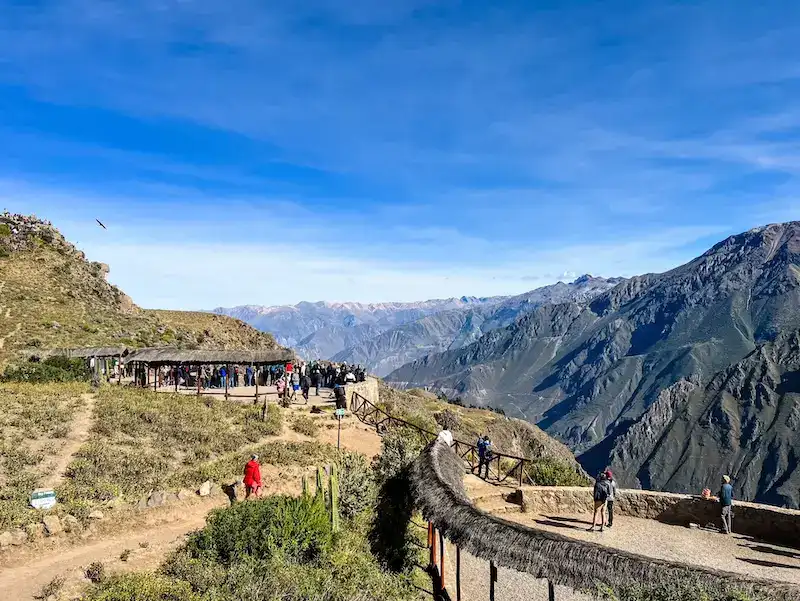
If you’re booked on a day trip to Colca Canyon, you likely already know this isn’t a quickie excursion from Arequipa. The hours listed on your tour make that obvious for you.
Most tours run anywhere from 13 to 16 hours, depending on the proposed stops, traffic, and lingering allowed by your guide.
Our day started well before dawn (like, 3am). You’ll likely get a call or text the night before your tour, firming up a pickup time at your Arequipa accommodations.
Once you and the rest of your group are gathered up, you’ll hit the road for about three hours until you reach Chivay for breakfast. We had a small bus full of people, not a giant tour bus, which helped with the amount of time we spent picking people up.
Note: You will spend a lot of time in the vehicle. If you suffer from motion sickness, take some meds or pack your wearable relief. I’m a big fan of the Reliefband these days, especially when I’m on the water or in a bus navigating mountain passes.
If you’re not sleeping for the first leg, you’ll notice that the scenery changes quite a bit as you leave Arequipa behind. You’re traveling through the high Andes, and there are plenty of opportunities to see wildlife and stop at viewpoints in the region.
The main event comes shortly after breakfast, though.
You got up extra early (or maybe you never went to bed) for Cruz del Cóndor. The birds are generally most active in the morning as the sun creates the thermals they need to soar. By mid-morning, they’re at rest.
Now, I’ve read a lot of reviews about Colca Canyon tours. While there are complaints about things like the length of the day and musical tastes of the guides, I haven’t seen any where people are complaining about a lack of birds.
We had about an hour to walk the rim and observe several condors during our visit. Watching them glide through the canyon already made the long drive worth it.
We also saw a guy dressed as a condor, likely waiting for tourists to take photos with him and demand payment. We didn’t investigate that too closely.
Note: The altitude is no joke. Cruz del Cóndor sits at roughly 12,000 feet, so even walking around the viewpoint can leave you feeling more winded than you’d expect. Take it slowly, drink plenty of water, and don’t feel like you need to power through if you’re feeling the effects.
After you’ve seen the condors, the day turns into more of a sightseeing tour of the Colca Valley and surrounding region.
Before our lunch break, we had the option to pay a little extra to hang out at the Chacapi Hot Springs near Yanque.
It didn’t look enticing to us, so we got coffee, ate our packed lunch, and added some more steps while people who wanted to partake did their thing.
Some group tours include your meals in the ticket price. Just don’t expect culinary wonders on a group trip, unless it’s a food tour.
A stop we enjoyed post-lunch was Antawilke, an archaeological site with pre-Inca terraces that shows you how people have cultivated this landscape for centuries. Mirador Antahuilque is a popular spot to see the terraces from above.

From there, we went to Maca, the most “tourist trap” pause of the day. It felt like one of those mandatory spots tour groups go to as part of a handshake agreement with handicraft shops.
Honestly? Whatever. We’ve done enough group tours that this kind of thing doesn’t really bother us.

If you’re someone who hates being shuffled off to souvenir shops and tourist stops, you may feel differently. For us, it was just one part of the day, and we didn’t let it ruin the experience.
From there, we drove through the Salinas and Aguada Blanca National Reserve. It’s known for its volcanic landscapes and wildlife, including vicuñas. Your guide will likely stop the bus if there’s a particularly good animal sighting near the road.
How much does it cost to visit Colca Canyon?
How much you’ll spend on a Colca Canyon trip depends on how you get there and how long you stay. The easiest option is a guided tour from Arequipa, with transportation, a guide, and most of the stops along the way bundled into one price.
There are quite a few of these tours out there, and many cost under $50 per person. Entrance fees to Colca Canyon typically aren’t included, so expect an additional $20 on top of your tour cost.
That’s still pretty cheap for a full day, even if you have to cover your meals, too. Our tour came with breakfast, but we had to cover our own lunch.
Fun fact: We had a packed meal with us from the hotel because we missed out on the hotel breakfast that morning. They were nice enough to pack us some food, so that felt like a real win come time to wake up at 2:45am.
If you stay overnight, you’ll need to add your accommodation and potentially another day’s transportation or tour costs. Many of the tours online still cost under $100 per person for a two-day trip.
For us, the bigger consideration wasn’t really the cost anyway, as low as it was. It was the time commitment. A cheap day trip isn’t necessarily a bargain for everyone if you’re spending 14 hours getting there and back. You need to decide what your time is worth!
How much time do you need for Colca Canyon?
You can see the highlights of Colca Canyon in one day, but two days allow for a less frazzled excursion if you have the time.
A one-day trip from Arequipa is primarily about getting to the canyon, seeing the condors at Cruz del Cóndor, making a few more stops, and getting back to Arequipa. It’s a long day, but it works if you’re short on time.
Two days means you can stay overnight in the Colca Valley, spend more time exploring the villages and viewpoints, and add some hiking. It’s less of a marathon day.
If you’re interested in actually hiking down into Colca Canyon, you’ll want even more time. Three days of hiking or even a two-day hike are completely different experiences from the typical sightseeing day trip.
Is a Colca Canyon day trip worth it?
Yes, but it’s going to be a very long day.
We did Colca Canyon as a day trip from Arequipa because that was what worked for our Peru itinerary. We didn’t have the flexibility for a multi-day canyon trek, so if we wanted to see the canyon and the condors, this was our only option.
For us, honestly, it wasn’t a big deal.
We’ve done plenty of group tours, and we knew what we were signing up for, even despite the aggressive timeline. Some of the extra stops were interesting, if touristy, and we felt like there was an effort to make the most of the drive.
Seeing the Andean condors soaring over Colca Canyon was absolutely worth the trip alone.
When those birds start riding the thermal currents above the canyon, you forget that you’ve been awake since an ungodly hour, fighting off leg cramps in a packed van.

I can’t say whether I would’ve preferred the two-day trip, because we don’t have anything to compare our experience to. Having more time in the region probably would’ve made the experience even more rewarding, though.
If a one-day Colca Canyon trip is all you can fit into your Peru itinerary, I wouldn’t it just because it’s a long day.
If seeing Andean condors in the wild is something you really want to do, I think the payoff is worth the effort. And the cost of tours isn’t a barrier on this one, either.
When Colca Canyon Isn’t Worth Visiting
Colca Canyon isn’t going to be worth it for everyone. The biggest issue is the amount of time it takes to get there, especially if you’re doing a day trip from Arequipa.
I’d reconsider the trip if:
- You’re already cramming too much into your Peru itinerary. A Colca Canyon day trip is a long trip, and you’re giving up an entire day.
- You hate long drives. There’s no getting around it. You’ll spend a lot of time in a vehicle.
- You’re not particularly interested in seeing Andean condors. The canyon scenery is beautiful, but the condors are the big payoff for most visitors.
- You’re expecting a quiet nature experience. Cruz del Cóndor is a popular tourist stop, and you’ll be sharing the viewpoint with other travelers.
- You’re sensitive to high altitudes. The entire experience takes place at significant elevation, and some stops are extremely high.
- You have the time for a longer trip but don’t want to spend it on a rushed day tour. In that case, I’d look at an overnight or two-day itinerary instead.
For us, none of those were dealbreakers. We knew the day would be long, we were comfortable with group tours, and seeing the condors was something we wanted to do. So even though the logistics weren’t awesome, we were happy with our choice.
When is the best time to visit Colca Canyon?

The best time to visit Colca Canyon is during Peru’s dry season, generally from May through November. You’ll have a better chance of clear skies and good visibility, both of which matter when you’re there for both the canyon views and the condors.
We visited in May, and the weather was great. It was sunny, but temperatures were comfortable enough to spend time outside without feeling like we were roasting.
The best time of day to visit is in the morning. That’s when the condors are most active, and why any tour is going to pick you up at a ridiculous hour. They’re trying to get you to Cruz del Cóndor while the birds are doing their thing.
Most tours aim to reach Cruz del Cóndor around 8 a.m., when condor activity is typically at its best. Later in the morning, the birds become less active, so sleeping in isn’t really an option if seeing them is your priority.
If you have some flexibility, a weekday might be better over a weekend or holiday period because Cruz del Cóndor is a popular stop.
What month is best for Colca Canyon?
May and June are nice, as you’re coming out of the rainy season and into generally drier conditions.
That said, I wouldn’t build an entire Peru itinerary around one “perfect” month at Colca Canyon. Clear weather and getting to Cruz del Cóndor in the morning are much more important than obsessing over an exact date.
How to Get to Colca Canyon

The easiest way to get to Colca Canyon is on a guided tour from Arequipa. That’s how we did it, and for a day trip, it’s the most straightforward (and cheapest) option.
Your transportation, guide, and the major stops are all arranged for you, and you don’t have to worry about navigating any winding roads yourself. A private transfer is another option.
If you want to travel independently, you can also get to the Colca Valley by public bus or colectivo. Cabanaconde is the main base for travelers planning to hike into the canyon, while Chivay is the most common first stop for visitors arriving from Arequipa.
That sounded way too intense for our purposes, so I’m not going to pretend like I’ve done the research on that option!
How far is Colca Canyon from Arequipa?
Colca Canyon is about 136 miles (220 kilometers) northwest of Arequipa, but it’s not just a matter of going from Point A to Point B.
The journey takes several hours because you’re traveling through the mountains, with winding roads and elevation changes along the way.
Our tour left Arequipa around 3am stopped in Chivay for breakfast, and then continued toward Cruz del Cóndor to get to the viewpoint before 8am. That’s why you’ll see Colca Canyon offered as either a very long day trip or a multi-day experience.
Recommended Colca Canyon Tours
We booked a tour with Peru Baby Llama. There are A LOT of options that take essentially the same trip, but we made our decision based on the highest reviews.
Here are a few more options for day trips to Colca Canyon:
If you’re not up for a 14-hour day, there are several operators that offer multi-day tours to Colca Canyon instead. You’ll still have quite a bit of travel from Arequipa on your first day, and there may be some hiking involved.
Here are a few two-day options for you to peruse:
I’ve also read about travelers tackling Colca Canyon independently, including Colca Canyon treks. This isn’t an endeavor for new hikers, and again, you need to consider the altitude.
If you’re looking for what sounds like a pretty epic adventure in Peru, I’d still propose something guided, no matter what I’ve seen on other travel guides.
Here are a few options for hiking-heavy Colca Canyon tours:
Where to Stay Near Colca Canyon
If you have the time, staying overnight near Colca Canyon can make the experience more enjoyable. That’s not what we did, but Chivay seems to have a good selection of hotels.
Use the map below to browse your options:
You can also stay in Arequipa and visit Colca Canyon as a day trip, as we did. It makes sense if you’re short on time or don’t want to move hotels. Arequipa has far more accommodation and restaurant options than the towns around the canyon.
We liked the El Portal De San Lázaro, but browse the map below for more options:
Tips for Visiting Colca Canyon
Start with the altitude. Colca Canyon sits high in the Andes. Take it slow, stay hydrated, and don’t underestimate how much the elevation can affect you.
I was really struggling throughout our trip to Peru, and this was after giving myself time to acclimate. It’s no joke.
Here are a few other things I’d keep in mind:
- Bring snacks. You’ll have breakfast and lunch stops on most organized tours, but having something of your own is useful during such a long day.
- Dress in layers. Temperatures can change dramatically throughout the day, particularly when you’re moving between high-altitude views and the lower valley.
- Bring sun protection. The high-altitude sun is intense, even when the air feels cool. Pack your sunscreen and a hat if you’re extra sensitive.
- Don’t count on every stop being amazing. Most group tours include several tourist-oriented stops. Some you’ll love, some you’ll be “meh” about.
- Pack some cash. You should tip your guide, and Peru overall is less credit card-friendly than many destinations you may be used to.
So, is Colca Canyon worth visiting?
Yes. If seeing Andean condors in the wild is on your Peru wish list, Colca Canyon is worth the effort. Even if you didn’t think they were, the wildlife aspect of your visit will meet even the highest expectations.
I’m not going to pretend our day trip was relaxing, though. If we had to do it over, I’d probably give ourselves more time in the Colca Valley instead of the marathon day trip, but even so, I don’t have regrets.
If a day trip is the only way Colca Canyon fits into your Peru itinerary, I wouldn’t let the long hours scare you off. The condors are pretty damn spectacular.
Content to check out for South American travel:
- Read Our Crazy Peru Fail Story!
- How to Spend an Incredible Day in Cusco
- Why Machu Picchu Meets Expectations
- Plan a Trip to the Salt Cathedral of Zipaquirá
- A Guide to the Best of Easter Island
Destinations for wildlife and nature lovers:
- Planning South Africa for First-Timers
- Honest Reactions From an African Safari
- A Guide to Whale Watching on Tenerife
- An Ethical Guide to Elephants in Thailand
- Top Wildlife and Hikes at Yellowstone

Want to see more?
Subscribe to my biweekly newsletter for hot travel tips I come across, weird stories you won’t see elsewhere and perhaps lifelong friendship.
Too much, or just enough?
