
Planning three days in Yellowstone National Park and not sure how to organize it all? With 2.2 million acres, dozens of geyser basins, and some of the best wildlife viewing in the country, Yellowstone can feel overwhelming fast.
This detailed three-day Yellowstone itinerary breaks the park into logical sections so you can avoid backtracking, minimize driving, and still see the highlights.
You’ll visit icons like Old Faithful and the Grand Canyon of the Yellowstone, explore multiple geyser basins, and spend time in wildlife-rich areas like the Lamar Valley.
I structured this route to make the most of three full days in Yellowstone, balancing must-see landmarks with lesser-visited stops that make the park feel as wild as it can.
If you only have three days, this is exactly how I’d do it again.
Quick Tips for Your Yellowstone Visit
Your Flight: It’s not likely you’ll find deals at the closest airports to the park. That’s Jackson Hole, Yellowstone Regional, Bozeman Yellowstone International, or Idaho Falls Regional.
If you’re on a longer road trip, Salt Lake City could be a more affordable option for flights. Use Skyscanner to watch flights either way. Love deals? Subscribe to Going.
Your Accommodations: I get into specifics in this guide, but you’ll be choosing between staying in the park, the pricey option, or outside of the park, the budget-friendly but less convenient option.
Browse Booking.com or Hotels.com to explore hotels near Yellowstone. Vrbo is my Airbnb alternative.
Your Ride: You’ll need a car to get to and around the park. Book a rental car ahead of time.
Top Spots: Meet Old Faithful, admire the Grand Canyon of the Yellowstone, and get stuck in a wildlife traffic jam in the Hayden Valley.
Disclosure: Travel on the Reg uses affiliate links to keep things running around here. At no additional cost to you, I earn a lil’ commission if you make a purchase. Any income earned supports the upkeep of this site. I appreciate you!
Park Fees at a Glance
Yellowstone National Park charges $35 per private vehicle for a seven-day pass. Motorcycles are $30, and individuals entering on foot or bicycle pay $20.
Non-U.S. residents aged 16 and older must pay an additional $100 per person fee unless they are entering with an America the Beautiful annual pass or other qualifying pass.
If you plan to visit multiple national parks within a year, the America the Beautiful annual pass ($80 for U.S. residents) is usually the most cost-effective option.
Yellowstone Three-Day Itinerary at a Glance
Day 1: Upper and Lower Geyser Basins
- Old Faithful
- Observation Point Trail
- Black Sand Basin
- Grand Prismatic Spring
- Firehole Swim Area
Day 2: Wildlife and Waterfalls
- Mammoth Hot Springs
- Wraith Falls
- Roosevelt Lodge
- Lamar Valley
- Dunraven Pass
Day 3: Canyon Area and Yellowstone Lake
- Grand Canyon of the Yellowstone
- Hayden Valley
- Natural Bridge Trail
- West Thumb Geyser Basin
- Yellowstone Lake
Day 1: Upper and Lower Geyser Basins
I’ll include some options for food stops as they’re available as we move through this three-day Yellowstone itinerary. If you’re someone who likes to pack a lunch, that’s a great idea when exploring the park.
You’ll have more time for hikes, and there are loads of picnic opportunities to be had. To be honest, our national parks aren’t known for their fine dining anyway.
Note: I trust that if you are a breakfast person you can handle your business. We’d bring bars and snacks with us in the car for most of our Yellowstone adventuring, but if you’re in need of a sit-down breakfast, all of the in-park lodges offer that.
I always recommend an early start to the day, as that means fewer tourists and less park traffic. Besides, when you see this list of what to see in Yellowstone, you’ll just HAVE to get an early start.
Stop 1: Old Faithful

The West Entrance to Yellowstone is closest to Old Faithful. It’s also the most popular, so get there early in the morning to avoid long wait times if you’re not staying inside the park.
The name of this geyser isn’t a misnomer. The folks at the adjoining Old Faithful Inn mean business when it comes to their posted predictions on when she’ll blow. Follow what they’ve posted, plus/minus a half hour or so.
You can also grab a snack or a packed lunch there if you’re with someone who gets hangry. If you miss it because you had a blowout of your own of some sort, it’s Old Faithful for a reason. You’ll have more opportunities to wait for her to erupt.
Stop 2: The Upper Geyser Basin

If you’re not over the crowds yet, follow the boardwalks for additional geyser-viewing opportunities in the Upper Geyser Basin, like the steamy Castle Geyser. That one comes with predictions sometimes.
While there, watch your step, not for geysers, but for Instagram models sunbathing. Spend some time taking in those spouting marvels until you’ve had your fill and feel the need to leave those crowded boardwalks.
More attractions here include:
- Daisy Geyser: The park service has this one on a schedule as erupting every 120-210 minutes or so. I’m kidding. They’re on their own schedule around here.
- Grand Geyser: This one boasts the tallest eruptions of predictable geysers in the world, with bursts of up to 200 feet every four to eight hours.
- Spasmodic Geyser: This fountain geyser is known for its short bursts and bubbles more than anything else, hence the name. Expect activity every one to three hours.
- Grotto Geyser: Grotto Geyser is more unpredictable with 15-foot bursts happening every few hours up to just once a day. Its odd shape is the draw here.
- Morning Glory Pool: This popular Yellowstone hot spring is all about the colors, much like the Grand Prismatic Spring, thanks to the bacteria in the water.
Stop 3: Observation Point Trail

If you timed your Old Faithful visit with a busload of tourists arriving for the next round of magnificence, hit the Observation Point Trail. I’d remember if it was strenuous, so it must not be that bad.
You’ll have the opportunity to observe — I see what you did there, National Park Service — the entirety of the Upper Geyser Basin below once you get to your next destination. See all of the thermal features you were jostling for space for down below from here.
Do you add some time to check out the Solitary Geyser, a frequent eruption site? The answer is yes, yes you do.
It’s a little over 2.5 miles to do the whole trek from the visitor’s center below. It truly was quite solitary. We were the only two there, a welcome thing at a crowded park.
Stop 4: Black Sand Basin

You can head back to the car next for a quick drive up to Black Sand Basin. There’s a boardwalk trail there that takes you by the Cliff Geyser, which erupts every few minutes, the Rainbow Pool, and the Emerald Pool.
Snap a bunch of pics and marvel at the colors. You’re unlikely to see colors this brilliant anywhere else in your travels throughout the United States.
Stop 5: Biscuit Basin & Mystic Falls
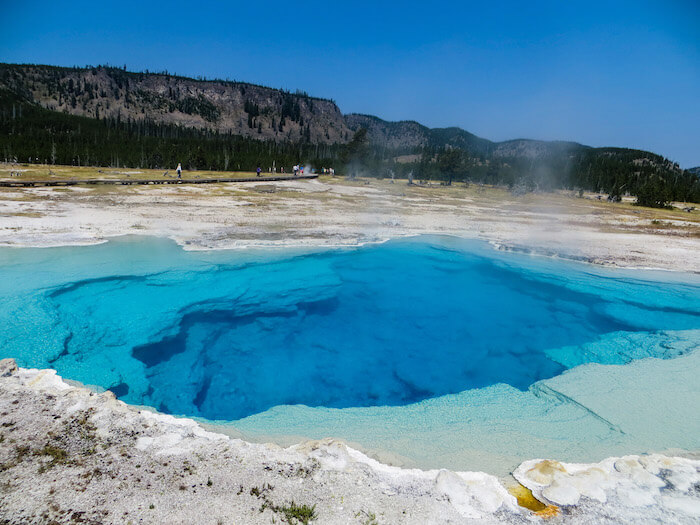
Just a few minutes north, you’ll stop at the Biscuit Basin.
Fun fact: There are no biscuits here, so I hope you packed those snacks.
You’ll find more lovely pools, like the vibrant Sapphire Pool, and a trailhead to Mystic Falls.
The trail is a not-so-stressful 2.4 miles to a creek and the 70-foot falls. I love a good water feature when it comes to my outdoor activities, so felt this was worth it. Just don’t expect Niagara.
We arrived at the same time as a large guided group, so things got a little hectic in the more narrow sections. You don’t need a guide on this one, by the way. The trail is well-marked.
Stop 6: Midway Geyser Basin & Grand Prismatic Overlook Trail
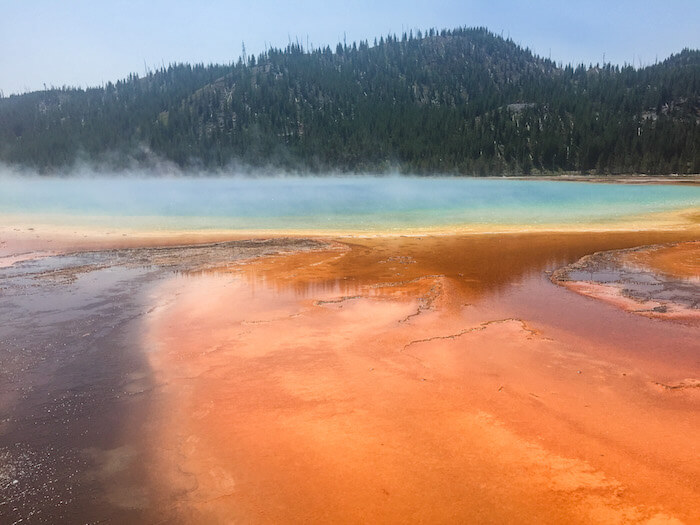
This whole day is all about the geyser thing, so don’t quit on me just yet.
North of those steamy biscuits, you’ll make a stop at the Midway Geyser Basin. This one is spectacular, and where you’ll see the Grand Prismatic Spring and the Excelsior Geyser Crater.
The Excelsior was the world’s largest geyser back in the day when it was active. It leads a quieter life now, albeit still an impressive one.
If you want to hike up to an overlook of the Grand Prismatic Spring, you can do that here on the Grand Prismatic Overlook Trail. It’s a little over half a mile up to view the basin below.
Visitors with more time may want to hit the Fairy Falls Trail, instead. You’ll get both the Grand Prismatic Overlook and a view of Fairy Falls on this one, but it’s a nearly five-mile roundtrip hike.
Stop 7: Lower Geyser Basin
A short two-mile drive north will drop you at the Lower Geyser Basin, where an easy boardwalk trail will get you acquainted with the Fountain Paint Pots.
A one-way drive will also get you closer to the Great Fountain Geyser.
Yellowstone staff make predictions on this one, too, and YouTube videos tell me it’s a goodie. Intervals are much longer, though, so if you’ve got your heart set on this one, check on those predictions ahead of time so that you can time things right.
Stop 8: Firehole Swim Area

You’ve made it to the relaxation portion of your day.
You’re probably a little bit sweaty from your walkabouts and want something akin to a hot tub situation. This won’t be that, but it’s super refreshing nonetheless.
To get to the Firehole Swim Area, also known as the Firehole River Swimming Area, drive along Firehole Canyon Drive until you come upon a line of cars along the side of the road.
This is your signal to do the same unless you want to do the same one-way loop again. (I know this because we did it. No one told me not to at the time.)
Note: On your way there, you’ll also pass an overlook for Firehole Falls. It’s worth a quick stop if you enjoy water features as I do.
Once you’re there, you have the option of changing in the toilet facilities or your car. Change in your car. You’ll thank me later. Allow people their dignity if you see them doing the same.
The swimming area itself is supposedly warmed by the nearby hot springs, but if you’re a delicate flower like myself, you’ll find the water temps quite cool. It’ll feel good after a bit, I swear.
Check current conditions before you go, as this one doesn’t open until mid-summer.
Stop 9: Overnight
Following our swim, we called it a day and headed to our accommodations for the night. Dinner options are limited while in Yellowstone to what you’ll get at the park lodges.
If you haven’t done any grocery shopping, here are your best bets in the Old Faithful area:
- The Old Faithful Snow Lodge Geyser Grill: This is a fast-casual establishment for burgers, sandwiches, and pies. Hours are limited outside of peak season.
- Old Faithful Snow Lodge Obsidian Dining Room: This is a fancier option, but honestly, I wouldn’t bother with fine dining prices while in the national parks.
As far as where you should bunk for the night, we stayed at the Old Faithful Snow Lodge on night one. It’s super convenient if you’re starting your trip off with the geysers, but our experience wasn’t the best.
We were in the lodge, not the cabins, where the walls are paper-thin. If you’re able to get a top-floor room somehow, you may have a more pleasant stay. Otherwise, you may be at the mercy of whatever noises are coming from your upstairs neighbors.
I’ll have more options for you at the end of this itinerary, so keep on reading for tips on accommodations.
Day 2: Wildlife and Waterfalls
You’ll be doing some driving today, but you’ll still have lots of opportunities to explore on your feet and stretch your legs as you see more of the park’s geological mysteries.
You’ll also have some opportunities to get up close and personal with wildlife today, so review those national park rules.
All that really means is don’t do anything ridiculous. That includes “saving” a baby bison that looks like it’s cold by putting it in the trunk of your car or getting gored by a mama bison because you got too close for that selfie.
Fun fact: Your photos will be impressive enough without all that. I promise.
I’m also including a lunch stop today, as it coincides with a lodge that boasts some historical significance. If you got a late start to the day, though, packing a lunch is never a bad idea.
Stop 1: Norris Geyser Basin Museum
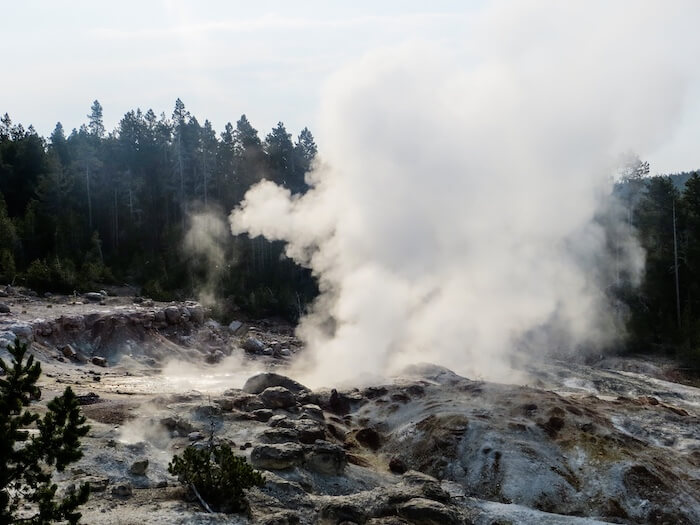
Your first stop is the Norris Geyser Basin Museum, about 45 minutes away from the Old Faithful area. It’s a trailside museum that gives you an overview of what you’ll see on the loops outside.
Those loop trails will take you past the Porcelain Basin and Back Basin. Highlights include the Emerald Spring and Steamboat Geyser.
Stop 2: Mammoth Hot Springs
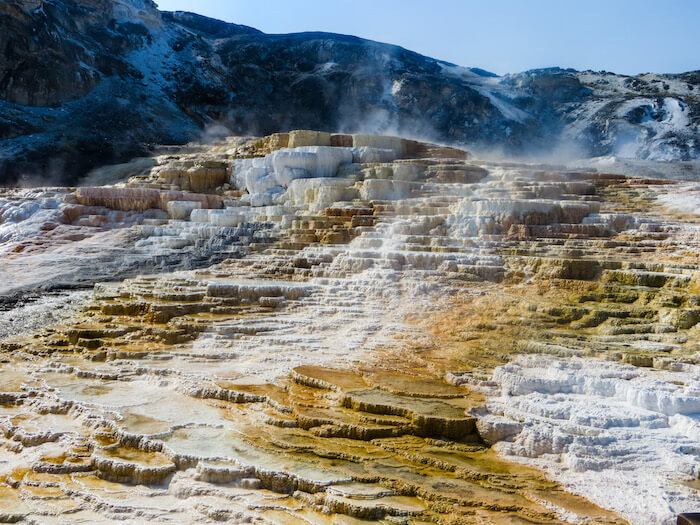
Another 45 minutes north of Norris, you’ll arrive at the Mammoth Hot Springs, or more simply, the Mammoth Springs. Walk along the boardwalks here to check out all of the fantastic thermal features, including the Minerva Terrace pictured above.
I know I say to leave the boardwalks for hiking opportunities, but seriously, where you see steaming things, stay on the marked walkways. People have died doing otherwise and I’m not being dramatic here.
Stop 3: Wraith Falls

For a quick leg stretcher, head east to Wraith Falls. This short trail of just about a mile roundtrip will take you to the base of the nearly 80-foot Wraith Falls. The falls flow into the nearby Lupine Creek. That all sounds so magical, right?
Stop 4: Roosevelt Lodge

If you’re hungry and want an actual sit-down meal — or a to-go meal, as you can do that here, too — you can do that at the Roosevelt Lodge. It’s another 13 miles east of the falls at the Roosevelt Lodge Dining Room.
I’d recommend this stop anyway, as the lodge is listed on the National Register of Historic Places. More generally, the Tower area where it sits was at one point a crossroads for Native Americans, then trappers, then explorers, then presidents.
The lodge itself was built in 1920. The surrounding historic district today is made up of more than 140 buildings, including a variety of cabins. It’s also got some potential for bison. We saw a big boy during our own visit!
Stop 5: Lamar Valley

If you’re up for a highly recommended side trip and have the time for it, the Lamar Valley is 30 miles out and back and boasts some of the best wildlife spotting in the park.
Expect bison, elk, and antelope at the very least, and perhaps even a wolf or two…or more, since they like the pack life.
I mention time constraints here because if you do run into wildlife, you may experience the beloved wildlife traffic jam. Bison in particular like to hang out on the road and get real gruff with you if you dare pass by.
Stop 6: Trout Lake

If that side trip took longer than you thought and you need fresh air, this 1.2-mile trail to Trout Lake just east of the Lamar Valley offers even more wildlife spotting. This time, you can do so on your feet.
The lake is named for all of the trout swimming alongside, but it’s also known for otters and osprey. We didn’t see either of those, which broke my heart just a little bit. I do love a good otter. Nevertheless, it was a nice trail through some shaded forest.
Stop 7: Dunraven Pass/Mount Washburn Trail
Continuing along Grand Loop Road heading east, you’ll meet up with Dunraven Pass. At 8,859 feet, this is the highest road pass in the park, so those ears might be popping at this point.
Even higher is the summit of Mount Washburn, a popular hiking trail that starts at Dunraven Pass and gets you up to 10,243 feet.
We didn’t hike Mount Washburn, and I do have some regrets about that. We just didn’t have the time or the energy to attempt a challenging hike like that at the end of an already active day.
The panoramas are supposed to be spectacular, with great wildflower action to be had in the summertime.
If you’re interested, I’d recommend starting your day at that trailhead and moving your itinerary around to accommodate that. Otherwise, make sure you hit Dunraven Pass at the very least.
Stop 8: Canyon Visitor Education Center

You’ll end your day at the Canyon Visitor Education Center. I’m always up for some education about all that I’ve seen and will see in our national parks.
This one will give you an overview of the park’s canyons in addition to other geological features throughout Yellowstone.
If you have some extra time because you skipped the hikes today, you can explore some of the Grand Canyon of the Yellowstone that kicks off the next day.Both scenic drives are just south of the education center.
Stop 9: Overnight
Before you hit the hay, the Canyon area has a few food options to stave off your hunger:
- If you’re looking for a sit-down meal, ensure you make all of the necessary reservations. The Canyon Lodge M66 Grill requires them.
- The more casual Canyon Eatery is where we decided to grab some bites. They have two options in this cafeteria-style spot, Slow Food Fast and Fresh Woks.
We stayed at the Canyon Lodge & Cabins for the next two nights of our Yellowstone itinerary. The lodge was a lot more budget-friendly compared to anything in the geyser areas, while still convenient to what we’d see on our third day in the park.
Day 3: Canyon Area and Yellowstone Lake
You’ll continue your exploration of the park starting in the Canyon area today, and do some more wildlife spotting, too. A packed lunch would be highly recommended here.
If you’re already in the Canyon area, the Falls Cafe in the Canyon Lodge offers some decent to-go options.
Stop 1: Grand Canyon of the Yellowstone (North Rim Drive)

Yes, you’re reading right. There is a grand canyon in Yellowstone, too, aptly named the Grand Canyon of the Yellowstone.
If you’re not impressed by the Grand Canyon in Arizona — I know an odd duck that called it a big hole in the ground — you may not be into this.
That makes me worry about what DOES impress you, though.
There are two drives available to experience this 20-mile-long, 1,000-foot-deep geological feature. How much time you spend on each is really up to you, as there are some opportunities for trail activity throughout.
At the very least, hit up all of the available viewpoints to see the falls as they flow over the colorful canyon walls.
The north rim drive starts a little over a mile south of Canyon Junction. It’s a one-way road, and it’ll take you to three different stops:
- Inspiration Point
- Grand View
- Lookout Point
These are all easily accessible, park-and-view spots for you to access the canyon.
For some exercise to kick off your day, the Brink of the Lower Falls Trail will take you down for a closer look at the Lower Falls.
You’ll still be able to see them from any of the lookouts above or from the easier paved trail at the Brink of Lower Falls pullout.
Stop 2: Grand Canyon of the Yellowstone (South Rim Drive)

The south rim drive starts a little over two miles south of Canyon Junction and will take you to additional vista points in the canyon.
The first stop on the drive will be a parking lot leading to a viewpoint of the Upper Falls. At one time, this is where you’d access the steep Uncle Tom’s trail, but that one is indefinitely closed.
At the south end of the drive, you’ll meet up with Artist Point. There’s an easy paved trail here from the parking lot to a view of the Lower Falls, the Yellowstone River, and all of the canyon colors that make this a favorite photo spot.
Stop 3: Hayden Valley

Continue south to meet up with the Hayden Valley, a great spot to get those bison-in-the-road photos you know you want to bring back home. We came upon some massive wildlife traffic jams while we were there, which is very fun unless you’re in a time crunch.
If you’re there in the summer, which you likely are, the bison may be feeling a little bit randy. July and August are mating seasons for the herds.
Just listen to what the park service says and exercise even more caution than you usually would around a 2,000-pound animal.
Stop 4: Mud Volcano Area

While in the valley, you’ll come across the Mud Volcano Area. Explore the boardwalks at your leisure and watch the steam rise from these hydrothermal features.
As always, when things are steaming, don’t blaze your own trail. Highlights include the Churning Caldron, Sour Lake, and the Dragon’s Mouth Spring.
Stop 5: LeHardy’s Rapids

Before leaving the valley, you’ll have one more easy stop at LeHardy’s Rapids. There are two available pullouts to view the rapids, either off of a short trail or a boardwalk.
They’re named after the topographer Paul LeHardy, who took a dip in the rapids when his raft overturned. I can joke like that because I know he survived.
This is also a pleasant picnic stop if you packed a lunch, which I hope you did.
Stop 6: Fishing Bridge
The Fishing Bridge is an easy photo stop and an easy stroll if you want to head across and back. Originally built in 1902, it was replaced in 1937 with a sturdier version and was a popular place to fish at that time. That shouldn’t surprise anyone.
A decline in the local cutthroat trout population ended that practice, though, so all you can do on the bridge today is watch the fish swim along from above. They’re likely pretty happy with that turn of events.
Stop 7: Natural Bridge Trail

You have a few options for hiking opportunities after all that canyon and wildlife splendor. I highlight the Natural Bridge Trail as it’s fairly easy at 2.5 miles with a great payoff at the end.
Storm Point Trail (2.3 miles roundtrip) and Elephant Back Mountain (3.5 miles roundtrip) are also within easy driving distance of the Fishing Bridge.
Storm Point Trail is just east. Elephant Back Mountain and Natural Bridge are west along Grand Loop Road.
We did all three on the same day and I survived to tell the tale. It really depends on what your day has looked like so far, and whether you lingered at the canyon in the morning.
Stop 8: West Thumb Geyser Basin

Tourists often miss out on this one, as it’s south of all the main spots at Yellowstone. I’d recommend against skipping out, as you won’t see another geyser basin on the shores of Yellowstone Lake that is this large.
The backdrop is pretty incredible, with steam and bubbles coming up to the surface of the already scenic lake. The easy one-mile boardwalk loop will take you to the highlights, including the Abyss Pool and Big Cone.
Stop 11: Yellowstone Lake Overlook

If you still have the legs, the Yellowstone Lake Overlook is a relatively short trail under two miles roundtrip that starts in the lot of the West Thumb Geyser Basin. That’s where you just oohed at all those calderas.
This one was harder for us than it likely should have been, as we had already tackled all three of the trails I suggested as options a few stops ago. It’s really not that hard, though, and the vista at the end of your climb is lovely.
I’ve read that the trail gets busy in the afternoons, but we were one of only a handful of hikers when we arrived toward the end of the day. I imagine timing is everything with this one.
Stop 10: Overnight
We returned to the Canyon Lodge for our overnight before packing up for Glacier National Park, another park I’d highly recommend, the next day.
Return to your food options from yesterday or hit the rest of the snacks you grabbed from any of the local grocery stores. If you got as many steps today as we did, you’ll be resting quite well!
Is three days enough for Yellowstone?
Yes, three days are enough to see Yellowstone’s major highlights if you follow a structured route. You’ll have time for geysers, wildlife valleys, and the Grand Canyon of the Yellowstone. Just assume you’ll want to plan a trip back! This park is that good.
More Things to Do in Yellowstone

Our Yellowstone itinerary allowed for three days in the park, but there really is SO much to do. You won’t be disappointed no matter what length of trip you plan unless it’s like, a three-hour tour. That’d be disappointing.
If you’re lucky enough to have more time in the park, check out these hikes and sights:
- Hike the Mount Washburn Trail. Missing out on this one was a great source of FOMO for me. It’s a steep climb of about 1,400 feet of elevation gain to great views.
- See the 132-foot Tower Fall. Head to the Tower Fall Overlook for an accessible viewpoint of this waterfall.
- Take a scenic boat ride on Yellowstone Lake. We went to the overlook, but you can actually hit the water on a boat ride or a fishing tour.
- Drive the Beartooth Highway. If you’re leaving from the northeast corner of the park, it’s easy to pick up a section of this 68-mile road over the border in Montana.
- Hit the slopes at Beartooth Basin. This is the only ski area in the country that’s open in the late spring and summer. The road is closed otherwise.
When to Visit Yellowstone
The best months to visit Yellowstone are the shoulder months of May-June and September-October. You’ll see fewer tourists and decent weather.
Keep in mind that you may not have all of the amenities available to you if you travel to Yellowstone outside of high season. Some places do shut down as the season slows.
If you want the best chance for sunny skies, you’ll have to contend with peak summertime in the park. Advanced bookings are a requirement in the summer for both your car rental and your accommodations.

How to Get to Yellowstone National Park
Yellowstone is primarily in Wyoming, extending into Montana and Idaho. It spans over 2.2 million acres.
To travel to Yellowstone, you’ll have to choose between budget and convenience. The airports in the towns of Cody and Jackson in Wyoming, Bozeman and Billings in Montana, and Idaho Falls in Idaho are all within driving distance:
- Yellowstone Airport (10 min. from West Entrance): Seasonal flights land at Yellowstone Airport, the closest option, but it’ll cost you. Welcome to Wyoming.
- Jackson Hole Airport (1 hour from South Entrance): You’ll be within stumbling distance from Grand Teton National Park, another gem, with this one.
- Bozeman Yellowstone International Airport (1 hour 30 minutes from the North Entrance): With more time, explore quirky Bozeman for a day or two.
- Yellowstone Regional Airport (1 hour 30 minutes from East Entrance): You’ll have Western-style attractions in Cody, but you won’t find any good flight deals.
- Idaho Falls Regional Airport (2 hours 30 minutes from West Entrance): If you’re staying in West Yellowstone anyway, this one is a good regional option.
- Salt Lake City International Airport (5 hours to West Entrance): Good deals await those OK with a longer Utah road trip from Salt Lake City. The drive is super scenic.
We went to Yellowstone as part of a longer multi-day road trip that originated in Portland. I’d highly recommend planning an epic Wyoming road trip of your own if you’re able.
READ MORE: Traveling through Jackson on the way? Use my guide to Jackson Hole to help you plan.
How to Get Around Yellowstone

The best route through Yellowstone is to travel along the Grand Loop Road, the main road that loops through the park. It takes at least four to five hours to do the loop in full.
I wouldn’t recommend tackling it all in one go, though. It’s 142 miles that beg for scenic stops and opportunities to stretch your legs.
From there, you can head north to explore the Upper Geyser Basin, home to the famous Old Faithful geyser and more geothermal attractions.
This Yellowstone itinerary assumes you’re tackling the park on a self-drive tour, even if you’re sticking to the Grand Loop. Start your days early as your best bet to avoid crowds.
Yellowstone does not require advance reservations for entrance like some of the other big national parks, but as a result, it gets busy as heck.
Where to Stay in Yellowstone National Park
You should stay in the park when visiting Yellowstone if you’re short on time. You can stay outside the park if you want to save some money. For your pick of accommodations in the park itself, plan well in advance.
If the Old Faithful Inn is on your bucket list, plan to book that one up to a year in advance.
If you’re on a budget, you have options for staying outside of Yellowstone that are quite doable if you don’t mind early mornings. West Yellowstone, for example, is about a 45-minute drive to Old Faithful.
Whether you want lodging accommodations in or around the park, including West Yellowstone, I have a handy guide to Yellowstone hotels and more.
The best entrance for Yellowstone depends on where you’re staying. The West Entrance is most convenient for geysers, while the North Entrance near Gardiner gives faster access to Mammoth Hot Springs and Lamar Valley.
Give Yellowstone as much time as you’re able.
This is a national park that gives off a completely different vibe if you’re only visiting for a short period of time.
The big tours that buzz through Yellowstone to see the geysers and little else miss out on some of the best trails and less popular stops in the park.
Less popular doesn’t mean they aren’t any good, by the way. This is a park that has a lot to offer, especially if you’re willing to give it more of your time.
Planning a longer road trip? Check out these guides:
- Fun Things to Do in Cheyenne (+ What to Avoid!)
- Top Day Trips for Road Trips from Cheyenne
- See One of My Favorites: Fort Collins, CO
- How to Plan Your Big Trip to Colorado
- Incredible Day Trip Stops From Salt Lake City
Love national parks? Read these next:
- Love Big Trees? See Sequoia National Park
- See the Incredible Arches at This Utah Park
- A Guide to the Best of Crater Lake National Park
- Hike the Wash at Capitol Reef National Park
- Visit Arizona’s Petrified Forest National Park

Want to see more?
Subscribe to my biweekly newsletter for hot travel tips I come across, weird stories you won’t see elsewhere and perhaps lifelong friendship.
Too much, or just enough?

WOW! Kind of ashamed to even admit this, but I never considered a multi-day Yellowstone trip! Saving this blog for the bucket list. Thanks for helping me see the light.
You’re welcome, Shelley! :) It’s the kind of place that just begs for more days.
This is such a detailed post on Yellowstone National Park. For someone like me, who wouldn’t be familiar with the area, it is perfect. My brother visited years ago and he never told me how beautiful the park is. Thanks for sharing.
You’re so welcome. I hope you’re able to visit someday soon!
I loved your post on Yellowstone. You have covered pretty much everything in this comprehensive post. Saving this post for later reference.
Thank you! I hope you’re able to make it out there soon!
Great itinerary! I’d love to visit the Sapphire Pool and also see some bison!
Oh, you’ll see ALL the bison at Yellowstone. They’re awesome!